

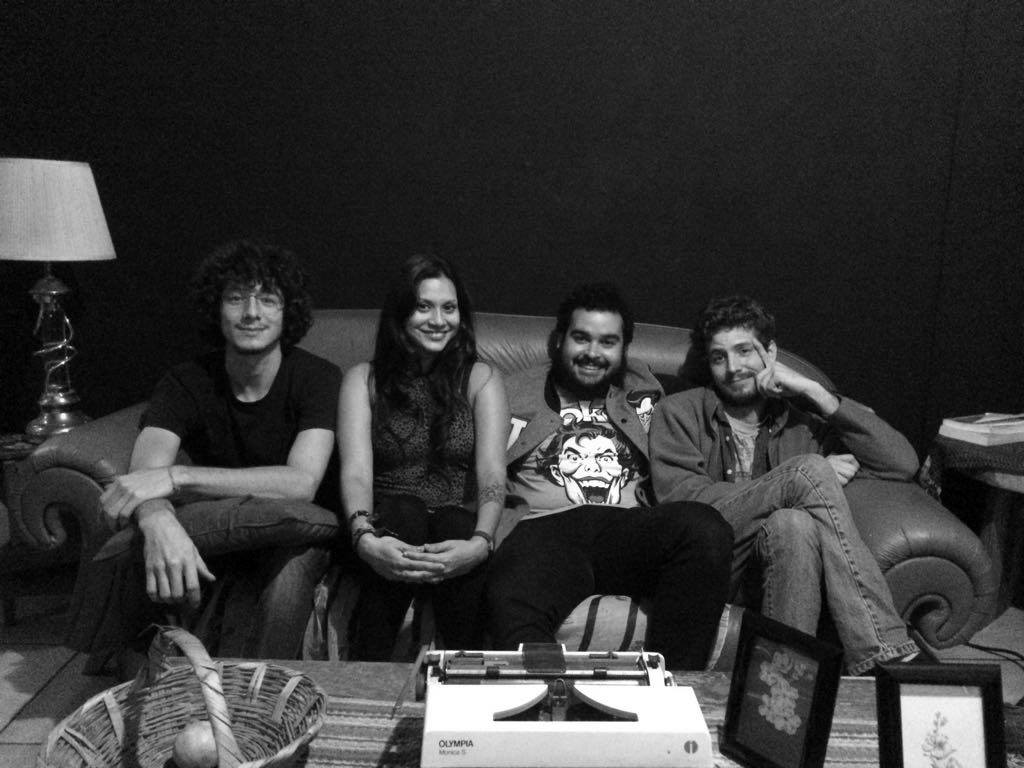
Decidí dejar a esta banda Originarios de Managua, Nicaragua para los últimos días del año como regalo por las fiestas, estoy muy cerca de cumplir 31 años y soy del pensamiento que para poder recibir en mi día yo tengo que dar también; estos chicos junto a sus instrumentos te maravillan en cuanto los escuchas debido a su sonido de mezclas que logran hacer que cada canción se vuelva única compensando la fluidez de variaciones espontáneas a la hora de estar sobre el escenario. Este trío que dio sus inicios como banda a finales del 2011 esta armonizada por Bruno Cortina, 23 años, Guitarra/Vocalista/Compositor, Evenor Gonzalez, 24, Bajo y Michael Cortina 27 años, Batería.
Bruno comenzó a tocar guitarra a los 11 años, a los 15 formo su primera banda de covers y a los 16 formo una banda con material original ya después formo otra en conjunto con su hno. Michael y otro amigo en el bajo.
Michael empezó con una banda local llamada «Ecos» dice haber sido su primera aventura musical, antes tenía una banda que se llamaba Necropollos Asados pero era un experimento.
Plural: Qué género era?
Michael: Era ruido, Nemi Pipali es el principal proyecto que tengo.
Evenor comenzó con el bajo cuando tenía 16 años y lo hizo de manera autodidacta con videos en YouTube junto al deseo de querer aprender a tocar el bajo.
Evenor: Me gustaba y quería aprenderlo; en la primera experiencia que tuve con el bajo fue con unos amigos, teníamos una banda que se llamaba Necroferrum era demasiado para lo que tocábamos pues tocábamos Mana y Enanitos Verdes. De hecho, toque con una banda de jazz q se llamaba «Inferfase» en la que Michael era baterista, se dieron las circunstancias socio geográficas pues el bajista que ellos tenían se fue del país, entonces los muchachos me preguntaron que si me animaba a tocar las canciones. El bajo es su instrumento secundario ya que su instrumento musical principal es la marimba, en Nicaragua toca Marimba en una banda que se llama Momotombo y fue la primera banda con la que obtuvo la proyección hacia el mundo artístico de manera seria, luego ya que tenía como más empapado de como funcionaba la música y se sintió con más seguridad.
Plural: Como se comformo la banda, y que fue lo que los inspiro a tocar juntos?
Bruno: La gran parte incontrolablemente nos juntábamos a jammear y a improvisar, un día fue como que bueno tenemos estas ideas, trabajemos la guitarra, batería, pues siempre ha habido esa cohesión con Michael; nos escuchábamos y ensayábamos por nuestra parte pero hacia falta algo más que el dúo de guitarra y batería y teníamos a este amigo Jorge Real, con el se formo la banda en el 2011, después de ese formato con Jorge Real, tuvimos a otro bajista, y se grabo el disco «CRECE» que es el que estamos promocionando y posteriormente se fue por cuestiones de trabajo y familia y se sabia con anticipación que se iba a ir y empezamos con Evenor y el formato actual es el que más fuerza tiene, más calidad, más entrega también hacia la música, entonces así ha ido evolucionando la banda.
Plural: De donde provino el nombre, Nemi Pipali?
Bruno: El nombre se nos ocurrió en conjunto con el primer bajista estábamos pensado en buscar fonéticamente algo que no fuera en español, no se cual fue la idea y nos pusimos a buscar en un diccionario nahuat, «Nemi» proviene del verbo vivir y «Pipali» el tiempo presente, vivir el presente.
Plural: Como clasificarían el sonido que tienen?
Michael: Ahorita nosotros nos estamos simplificando un poco, en cuanto a la gente que dice que somos rock experimental, por la energía que tocamos y experimental porque fusionamos bastante armonía, el jazz, ritmos de Latinoamérica, el blues, funk.
Bruno: Mezclado con bastante de lo que es el folklore latino en cuanto a los ritmos, pues distintas regiones de Latinoamérica; es increíble la riqueza musical, me entendés y justamente el ritmo es el fundamento de la música y es lo que caracteriza más que nada un género, entonces hay canciones adonde escuchas un poco del caribe, hay otras que escuchas un poco mas de samba, y es como una fusión que incontrolablemente vamos armando las canciones y terminamos mezclando porque pues es bien natural la idea de experimentar nuevos sonidos.
Michael: Buscar algo que nos interese a nosotros, y de esa manera podemos llegar a decir algo distinto.
Plural: Cuál fue el primer tema, como lo crearon y que los inspiro?
Bruno: El «Enano Cabezón», esa canción evoluciono bastante, la mayoría de las ideas pues por ejemplo esa canción en espeficico yo había escrito el riff, la melodía y el tema de la canción, creo que talvez dos años antes de formar el grupo y así lo montamos con el bajo y la batería y la guitarra y creo que esa fue la primera, después íbamos trabajando paralelamente nuevas canciones
Michael: Pero la del enano tiene una onda que el ritmo fue inspirado en los ritmos callejeros de la gigantona y el enano cabezón en las calles de Managua que son tres niños uno lleva un tambo grandote «boom» «boom» «boom» y el otro va con un redoble de «traca» «traca» cualquier ritmo pero por lo general » tracabara» «tracabaraca» viene el niño y dice una copla.
Bruno: Siendo un personaje folklórico el enano cabezón va de la mano con la gigantona
Michael: La quería enamorar.
Bruno: Exacto, es una historia que conecto a los personajes y se representa en gran parte lo que era el colonialismo inicial 1600’s ,1700’s se fue creando el mestizaje entonces el enano cabezón representaba al indio bajo de estatura y por tener una cabeza grande pues representaba la sabiduría que realmente no era respetada por los españoles y la gigantona de cierta manera es la mujer blanca alta, chela, rubia, entonces estos dos personajes que forman parte del folklore nicaragüense; toda Centroamérica y la región del pacifico, es un ritmo que se caracteriza por su aspecto, por su sabor tribal, las raíces, indígenas están bastantes conectadas con esa medida de tiempo de 6×8 si te pones a pensar; todo ha sido una mezcla y no algo nuevo no solo genéticamente sino que actualmente imagínate estamos mezclando géneros y ritmos de cierta manera. Es una continuidad de ir mezclando lo que somos por que es inevitable, hay tantas influencias, tanta variedad y tanta riqueza por todo el intercambio cultural, que gran parte ha sido forzado, se ha dado mucha violencia desde la colonización. Es inevitable para nosotros mezclar nuestras influencias que hemos tenido desde que escuchamos música con lo que nos ha rodeado desde pequeños el folklore de Latinoamérica todos hemos sido fans de géneros como el bossa nova, la trova, el son cubano, el son nica, ballenato, incluso bachata, cumbia, me entendés? hay tantos colores en ese aspecto de donde escoger.
De hecho, me sentí sorprendida porque empecé a sacar una lista de los sonidos que escuchaba para lograr encontrar un género en especifico y honestamente no me lo creía que me salieran tantos y dije no, mejor le pregunto a ellos Como clasificarían su sonido entonces, porque a mi parecer suenan un tanto stoner rock de cierta forma porque hay algunas canciones que son súper instrumentales y diferentes a las que cantan, sin duda alguna que este ultimo material de Nemi Pipali no es un álbum que lleva una sola línea es diferente, no te aburre.
Michael: La línea es la mezcolanza.
Bruno: Es bien interesante porque nunca pensamos en «vamos a mezclar esto» dejamos que la canción nos diga por donde ella quiere que la llevemos de cierta forma es bien extraño, la canción te habla y te dice dale cuatro vueltas y mete este acorde, es un proceso adonde vamos probando, y decidimos si lo dejamos atrás o lo ponemos, es como un experimento asi como cuando los científicos están en el laboratorio viendo que formula funciona. Es un disco en el que el proceso creativo es bastante libre, las canciones no fueron tan planificadas en términos de producción, y creo que eso es lo que nos caracteriza bastante, mucha gente nos dice que no saben que esperar y si realmente eso les gusta por que te permite contar una historia no solo a través de tus líricas sino de como estructuras tu melodía o tus versos con tus coros y los puentes ó la parte del interludio; si te fijas ninguna canción es verso, puente, coro, verso, puente coro, hay estructura pero naturalmente nos salimos de las estructuras cotidianas por ejemplo en la música popular encontras bastante esas estructuras, digamos el intro, verso, coro, verso y eso entonces realmente no respetamos eso en ese aspecto. Dejamos que haya espontaneidad a la hora de crear incluso en vivo hacemos variaciones, no tocamos igual. Te estaría mintiendo que siempre tocamos igualita la canción, las letras si se siguen igual con la estructura.
Plural: Cada cuanto practican?
Michael: Una vez a la semana, antes tres días a la semana por varios meses pero con toda la diversificación y el trabajo.
Evenor: Uno crece y tiene obligaciones.
Michael: Si, parece mentira y es difícil encontrar tiempo entonces de hecho queremos ensayar más.
Bruno: Para ya entrar al proceso creativo de lo que va ser el segundo disco queremos enfocarnos en eso y para eso también tenes que despejar bastantes cosas de tu mente y tu vida cotidiana por lo general lo mejor a la hora de proceso creativo si podes hacerlo irte lejos de tu zona de comfort y te llevas tus herramientas para crear e ir armando tu arte.
Plural: Cuánto tiempo les toma componer una canción?
Bruno: Fíjate que a veces puede ser por lo general un mes.
Michael: Cuándo nos ponemos plan un mes.
Plural: Esto es contando si es una canción con letra?
Bruno: Con la ultima canción por ejemplo, recuerdo que la comenzamos a tocar y decíamos «todavía no esta lista pero probémosla» también le damos chance a la música que respire y si a la hora de grabarla pues concluís y decís «esto es lo que es» y a grabar, tampoco que a la hora de grabar vas a estar improvisando pero hemos desarrollado una manera en que en cierto momento de las canciones, la canción nos da la libertad de probar y hacer pequeñas variaciones, yo creo que es la parte libre de la música.
Michael: También se puede aplicar el nombre «vivir el presente» ese momento se puede aprovechar y es estirar la canción.
Bruno: A veces estiramos una vueltas a la hora de los solos dependiendo del limite de tiempo que tenemos, son bien flexibles las canciones sin embargo tenemos que respetarla por que cada canción tiene su personalidad su característica, cada canción es como un pequeño hijo o hija.
Evenor: Como artista, queres que mas gente conozca tu arte, estamos en plan de poder tocar en otros países, no limitarnos a Centroamérica; todo en la medida que sea posible, así como es la filosofía de las canciones que nada es forzado y todo fluye entonces, las oportunidades se van dando es de aprovecharlas y queremos trabajar más canciones ensayar más, y eventualmente salir más seguido de Nicaragua.
Bruno: Salir de tu zona de comfort es muy importante porque la comodidad te va matar como artistas emergentes y lo primero que necesitas es compartir tu música si vos no haces que tu música le llegue a los oídos al publico no va pasar nada nunca, la música es para compartir aquí estamos y estamos alegres por muy cerca que estemos. Esta vez tuvimos dos presentaciones y es nuestra segunda vez visitado el país, la primera solo tocamos una vez, la pasamos súper bien y nos recibieron súper bien, nos aplaudieron, pidieron más canciones y eso es una de las cosas más bonitas cuando logras compartir lo que haces con nuevas personas, porque al final aprendes más y así es como logras crecer, no limitándonos ni creyendo que ya hemos llegado a un punto alto, nada que ver, es cuestión de saber que no hay limites y se trata de aprender y mantener la mente abierta como un paracaídas.
Nemi Pipali – Youtube
Nemi Pipali – Soundcloud
Nemi Pipali – Facebook
Nemi Pipali – Twitter
Nemi Pipali – Instagram
I decided to leave this band that is originated from Managua, Nicaragua for the last days of the year as a gift from me to you for the holidays, I am very close to turning 31 years old and I’m thinking that in order to receive in my special day I have to give something as well; these guys together with their instruments amaze you as soon as you listen to them because of their sound of mixes that manages to make each song become unique, compensating the flow of spontaneous variations when they’re on stage. This trio started as a band at the end of 2011 its harmonized by Bruno Cortina, 23 years old, Guitar / Vocalist / Composer, Evenor Gonzalez, 24, Bass and Michael Cortina 27 years old, Drums.
Bruno started playing guitar at the age of 11, at 15 he had his first cover band and at 16 he formed a band with original material and later he became part another band along with his brother, Michael and another friend playing the bass.
Michael started with a local band called «Echoes» he says it was his first musical adventure, before Echoes he was part of a band called Necro-pollo Asados, but it was an experiment.
Plural: What genre was it?
Michael: It was noise, Nemi Pipali is the main project I have.
Evenor started playing the bass when he was 16 years old and he learned by himself with videos on YouTube mainly driven by the desire to learn to play the bass.
Evenor: I liked it and wanted to learn how to play it. The first experience I had with the bass was with some friends, we had a band called Necroferrum and I believe it was too much for what we played because we played Mana and EnanitosVerdes, those kind of covers, I also played with a jazz band that was called «Inferfase» in which Michael was the drummer, the sociogeographic circumstances were given because the bass player they had left the country, then the boys asked me if I was interested to play the songs. The bass its my secondary instrument since my main musical instrument is the marimba, in Nicaragua Evenor plays Marimba in a band called Momotombo and it was the first band with which it got the projection towards the artistic world in a serious way, ever since I’ve had a better notion of how the music environment is and felt more secure.
Plural: How did the band began, and what inspired you guys to play together?
Bruno: The greatest part uncontrollably was getting together to jam and improvise, one day it was like how great we have these ideas, let’s work the guitar, drums, because there has always been that cohesion with Michael; we’ve listened and rehearsed on our part but we needed something more than the duo of a guitar and drums and we had this friend Jorge Real, the band started with him in 2011, after that version with Jorge Real, we’ve had another bass player, who was part of our album «CRECE» which is the one we are promoting at the moment he had to leave because of work and family issues and we knew in advance that he was going to leave the band and we started with Evenor and the current format is the one that has more strength, more quality, more passion towards music, and that’s how the band has evolved.
Plural: Where did the name «Nemi Pipali» came from?
Bruno: The name occurred and was presented to us in conjunction with the first bassist we were thinking about looking for something that was not in Spanish, I don’t know what the idea was and we started looking in a Nahuat dictionary, «Nemi» comes from the verb to live and «Pipali» the present time, which means live the present.
Plural: How would you classify the sound they have?
Michael: Right now we are simplifying, as for the people who say that we are experimental rock because of the energy that we play and experimental because we fuse some harmony between jazz, Latin rhythms, blues & funk.
Bruno: Our sound is mixed with a lot of what Latin folklore speaking in terms of rhythms from different regions of Latin America; the musical richness is incredible and precisely the rhythm is the foundation of the music and is what characterizes a genre more than anything. There are songs where you listen a bit of the Caribbean, there are others that you would be able to listen a little more samba, and it is like a fusion that we are uncontrollably putting together in the songs and we end up mixing because the idea of experimenting new sounds is quite natural.
Michael: We usually find something that interests us, and through that way we can communicate something different.
Plural: What was the first single and how was it created and what inspired it?
Bruno: » Enano Cabezon» ( Big Headed Dwarf ), that song evolved quite a lot, most of the ideas for example that song in particular I had written the riff, the melody and the theme of the song, I think maybe two years before the band existed and so we went ahead and set it up with the bass and the drums and the guitar and Indeed if I’m not mistaken I think that was the first one, then we were working on new songs in parallel.
Michael: But the dwarf has a wave that the rhythm was inspired by the rhythms on the streets because of the Giant Woman and the Big Headed Dwarf, in the streets of Managua there are three children; the one who carries a big tambo that goes «boom» «boom» «boom» another goes with a «traca» drumroll «traca» any rhythm but usually «tracabara» «tracabaraca» and afterwards comes out the third child who says a copla.
Bruno: Being a folkloric character the Big Headed Dwarf goes hand in hand with the Giant Woman.
Michael: The Big Headed Dwarf wanted the Giant Woman to fall in love.
Bruno: Exactly, it’s a story that connects the characters and is largely represented in the initial colonialism 1600’s, 1700’s, it was creating the metaphore then the Big Headed Dwarf represented the Indian low in stature and having a big head because it represented the wisdom that wasn’t really respected by the Spaniards and the Giant Woman in a certain way is the tall white woman, blonde, and so these two characters that are part of the Nicaraguan foklor; all of Central America and the Pacific region, is a rhythm characterized by its appearance, by its tribal flavor, the roots, indigenous people are quite connected with that measure of time of 6×8 if you think about it; everything has been a mix and not something new not only genetically but nowadays we are imagining, mixing genres and rhythms in a certain way. It is a continuity of mixing what we are because it is inevitable, there are so many influences, so much variety and so much wealth for all the cultural exchange, that a great part has been forced, there has been a lot of violence since the colonization. It is inevitable for us to mix our influences that we have had since we listened to music with what has surrounded us since we were small, the folklore of Latin America. We have all been fans of genres such as bossa nova, trova, cuban son, ballenato, even bachata, cumbia; There are so many colors in that aspect from which to choose.
I was surprised because I started to make a list of the sounds I was listening to in order to find a specific genre and I honestly did not believe that so many of them came out and I said no, I better ask them how they would classify their sound then, because in my opinion they sound somewhat stonerrock in a certain way because there are some songs that are super instrumental and different from the ones they sing, without a doubt that this last material by Nemi Pipali is not an album that has only one line, it is different, you don’t even feel when the album has been played for the second time, you will honestly not get bored at all.
Michael: The line is a mixup.
Bruno: It’s very interesting because we never thought about «let’s mix this» we let the song tell us where it wants us to take it in a certain way it’s very strange, the song talks to you and tells you to give it four laps and put this chord, it is a process where we are testing, and we decide if we leave it behind or put it on; it is like an experiment as well as when the scientists are in the laboratory seeing what formula works. It’s an album in which the creative process is quite free, the songs were not so planned in terms of production, and I think that’s what characterizes a lot, a lot of people tell us they do not know what to expect and if they really like that it allows you to tell a story not only through your lyrics but also how you structure the melody or your verses with the choirs and bridges or part of the interlude. If you notice any you choose song goes verse, bridge, chorus, verse, choir bridge, there is structure but naturally we left the daily structures for example in popular music you find enough of those kind of structures, let’s say the intro, verse, chorus, verse and sometimes we do not really respect that. We let there be spontaneity when it comes to creating even when we play live we make variations, we do not play the same; I would be lying to you if I told you that we always play the same song the same way or the lyrics, sometimes they get to stay the same with the structure.
Plural: How often do you practice?
Michael: Once a week, before we used to practice three days a week for several months but with all the diversification and work.
Evenor: One grows up and has obligations.
Michael: Yes, it seems a like lie and it is difficult to find time so in fact we want to try more hours and days.
Bruno: We honestly like to focus in order to get in the creative process of what will be the second album and to achieve that you also have to clear enough things from your mind and your daily life, usually the best time to get to this to creative process is to go away from your comfort zone and take your tools to create and build your art.
Plural: How long does it take you to compose a song?
Bruno: Sometimes it can be for a month in general.
Michael: When we plan it we usually take like a month.
Plural: This is just if it is a song with lyrics?
Bruno: With the the first song we played tonight for example, will be the new single that we will release very soon, that song I remember we started playing it and said «it is not ready yet but we also have problems» you got to let the music breathe and at the time when we were recording for the first time we all concluded and decided «this is what it is» and we recorded it, not that at the time of recording you will be improvising either but we have developed a way in which at a certain moment of the songs, the song gives the freedom to try and make small variations, I think it’s the part of music in which allows you to be free.
Michael: You can also apply the name «live the present» through that mindset of our creative process and that moment can be used when we are stretching the song through any kind of variation.
Bruno: Sometimes we stretch a few laps at the time of the solos depending on the time limit we have, the songs are very flexible however we have to respect it because each song has its own personality, each song is like a small son or daughter.
Evenor: As artists we want more people to know our art, we plan to be able to play in other countries, not to limit ourselves to Central America, and not just our art I mean everything as much as possible, just as it is the philosophy of the songs that nothing is forced and everything flows then, the opportunities are given and it depeds on you to take advantage, and we want to work more songs to try more, and eventually leave more often away from Nicaragua.
Bruno: Getting out of your comfort zone is very important because comfort is going to kill you as emerging artists and the first thing you need to do is share your music if you do not make your music reach the audience, nothing will ever happen, the music is to share; here we are and we are happy no matter how close we are. This time we’ve had two presentations and this is our second time visiting the country, the first one we only played once, we had a great time and they received us very well, they applauded us, they asked for more songs and that is one of the most beautiful things when you manage to share what you do with new people, because in the end you learn more and this is how you manage to grow, not limiting ourselves or believing that we have reached a high point, it is a matter of knowing that there are no limits and it is about learning and keeping your mind open like a parachute.
Nemi Pipali – Youtube
Nemi Pipali – Soundcloud
Nemi Pipali – Facebook
Nemi Pipali – Twitter
Nemi Pipali – Instagram
 thinkplural.com